Out now · A Business Novel
AI writes code that lies fluently.
Learn to spot it before it ships — through the story of a team that almost didn't. A novel about AI and Spec-Driven Development.
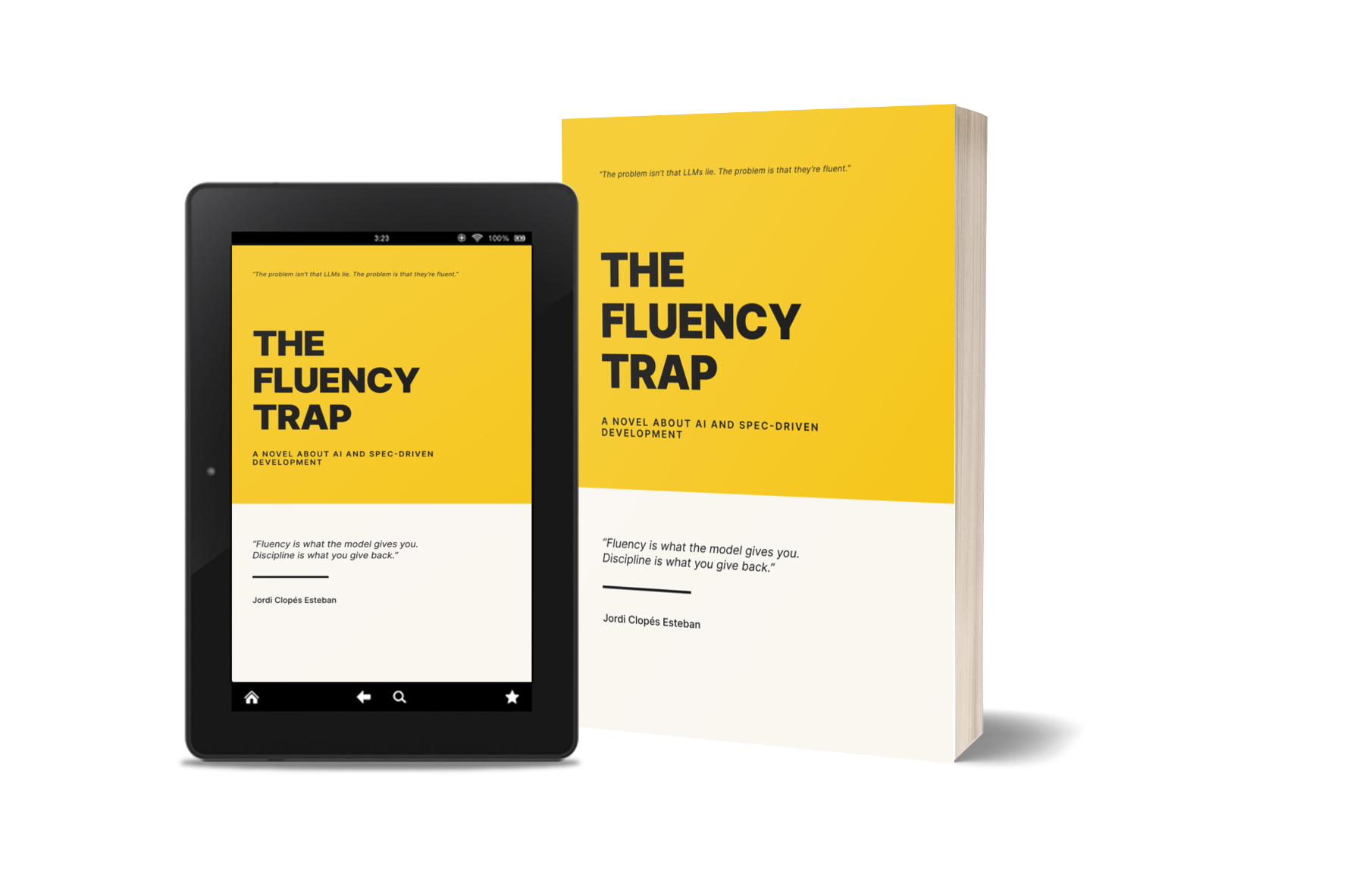
AI writes the code now. Someone still has to sign for it.
On a Tuesday morning, an engineer at a food-safety company discovered that 1,116 health inspection reports had shipped with their critical alerts inverted. The model had done exactly what it was asked. The ticket had been ambiguous. Three weeks of phantom outbreaks had already unfolded in Cleveland.
The Fluency Trap is the story of how Sarah Chen's team — and a parallel medical-triage team whose product falls under the EU AI Act — came back from the brink. Not by finding a smarter model. By learning the discipline around it.
What you'll learn about Spec-Driven Development
- To write a constitution before code.
- The five sentence patterns that kill ambiguity.
- Why two AI sessions catch what one cannot.
- What a regulator means when they ask who signed.
A novel about Spec-Driven Development for the AI era — and the regulatory floor that is about to ratify it.
For engineering leaders who ship AI systems that other people depend on.
10 things this novel will teach your team
- 01
Why “the model lied” is the wrong diagnosis — and what the right one is.
- 02
How to write a project constitution that an LLM can read and a human can sign.
- 03
The five EARS sentence patterns that kill ambiguity in requirements.
- 04
Why one AI session is a worse reviewer than two.
- 05
How to run adversarial review in clean context — and what that catches.
- 06
The named human sign-off that satisfies engineering, audit, and regulators in one signature.
- 07
How Spec-Driven Development maps to the EU AI Act, ISO/IEC 42001, and the NIST AI RMF.
- 08
The four anti-patterns to avoid: vibe-spec’ing, spec-as-documentation, EARS-theater, human-rubber-stamp.
- 09
Which open-source tools, agents, and adversarial-review frameworks to use today — and which ones to avoid.
- 10
The quiet cost of fluency — and why the discipline pays it down.
Essay
Read the opening scene.
Before the book, the essay. Cleveland — the function that lied, the eight lines that shipped, and the one syntax that would have caught it. Ten minutes. No email required.
The Bug That Reads Like a Textbook →Questions
What is Spec-Driven Development?
Spec-Driven Development (SDD) is a discipline for building software with LLM coding agents in a way that actually works. Instead of prompting an agent with an ambiguous ticket and hoping it picks the right reading, you write a specification first — in a syntax the model can parse without guessing — and the spec becomes the contract. The four operational practices are a project constitution, EARS requirements, sub-session isolation for adversarial review, and a named human sign-off. The Fluency Trap is a novel that teaches this discipline through story.
What is EARS syntax?
EARS (Easy Approach to Requirements Syntax) is a set of five sentence patterns invented by Alistair Mavin and colleagues in 2009 to remove ambiguity from requirements. The patterns force every requirement into one of five shapes — ubiquitous, event-driven, state-driven, optional-feature, unwanted-behaviour — leaving an LLM coding agent no room to invent a plausible-but-wrong reading. Chapter 8 of The Fluency Trap walks a team through adopting EARS.
Is this a technical manual or a novel?
Both. The 18 chapters are a narrative — characters, scenes, a year inside a regulated-software company — written to be read on a flight. The seven appendices are operational: SDD at a glance, EARS reference, a starter checklist, a curated open-source toolkit, regulation mapping (EU AI Act, ISO/IEC 42001, NIST AI RMF), recommended reading, and a glossary. You can read it as a story and apply it as a manual.
Do I need to know Spec-Driven Development already?
No. The novel introduces the concepts as the characters discover them. By Chapter 4 you'll know what a constitution is and why it matters. By Chapter 8 you'll know EARS. By Chapter 16 you'll have a concrete implementation plan you can drop into a real project.
How is this different from The Phoenix Project or The DevOps Handbook?
The Phoenix Project taught a generation of engineering teams why DevOps matters. This is the same form — a business novel followed by operational appendices — applied to the failure modes of LLM-based systems. If you've read Phoenix and want the AI-era equivalent, this is it. If you haven't, you don't need to: the novel stands alone.
What programming languages does it cover?
None specifically. The Fluency Trap is language-agnostic — it's about how teams write specifications that AI agents follow, not about syntax. The principles apply to Python, TypeScript, Go, Java, anything.
Is it relevant outside of regulated industries?
Yes. The regulated examples (healthcare triage, food-safety inspections) are the most visible case where fluent AI code can ship dangerous bugs. The underlying problem — code that looks fine because it sounds fine — applies anywhere a team trusts AI-generated output. If your team uses Copilot, Cursor, Claude Code, or any LLM coding agent, this book is for you.
What if I read it and it doesn't help?
Amazon's return policy applies: paperback returns within 30 days for full refund; Kindle ebooks can be returned within 7 days if accidentally purchased. No questions asked.

About the author
Jordi Clopés Esteban is a Solutions Architect based in Barcelona, building with LLMs at their core. He has a long background in network infrastructure, security, and open-source services — two decades designing, deploying, and securing the systems that other systems depend on: networks, VOIP, Linux migrations, cloud, and virtualised infrastructure.
He founded an award-winning open-source startup and has taught networking. The Fluency Trap is his first book.